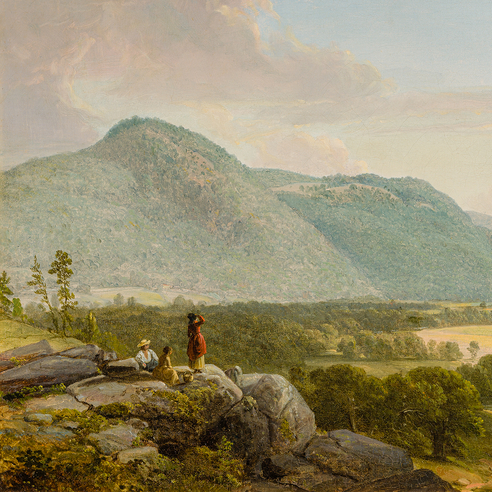
Asher Brown Durand was born in Jefferson Village (now Maplewood), New Jersey, to a family of Dutch and Huguenot origin. His father was a farmer as well as an artisan, a watchmaker, and silversmith who encouraged three of his sons, Cyrus, Asher, and John, to pursue careers as engravers. Accordingly, in 1812, Asher Durand was apprenticed to Newark engraver Peter Maverick. His aptitude was such that by 1817 he was Maverick's partner, dispatched to open a New York City branch of the firm. In 1820, John Trumbull, the eminent history painter and President of the American Academy in New York, commissioned the 23-year-old Durand to engrave Trumbull's The Declaration of Independence. (The original is at the Yale University Art Gallery, New Haven, Connecticut.) The partnership with Maverick foundered, probably over business tensions related to Durand's acceptance of the Trumbull assignment. The engraving, published in 1823, established Durand's professional reputation, and propelled him from the realm of commercial engraving toward the world of art.
Durand joined with his brother Cyrus in New York in a family engraving firm, A. B. and C. Durand, from 1824 to 1831. While Cyrus developed a solid business as a commercial and bank-note engraver, Asher moved steadily toward a career as a painter. He entered vigorously into the art life of New York City. In 1825, he was among the founders of the New-York Drawing Association; in 1827 he was a founding member of the artist-initiated and controlled National Academy of Design. Durand's early art pursuit reached its peak with his 1835 engraving of John Vanderlyn's Ariadne Asleep on the Isle of Naxos. (The original, painted 1812–14, is in the collection of the Pennsylvania Academy of the Fine Arts, Philadelphia). By that time, however, he was ready to give up engraving and commit himself to a career as a painter. From the time of his arrival in New York City, Durand had taught himself to paint. He was an auto didact, disciplining himself with a standard practice of making an oil copy of the original painting he was being paid to translate to line before embarking on the engraving process. He began his fine-art career as a portraitist, adding history and genre to his repertoire as he gained skill and confidence.
In 1834 Durand was one of four beneficiaries of the patronage of Luman Reed, a prosperous New York wholesale grocer who had begun to collect art and decided, in the mid-1830s, to concentrate his efforts in support of contemporary New York artists. Together with Thomas Cole, George Whiting Flagg, and William Sidney Mount, Durand painted commissioned works for Reed. Durand contributed a group of presidential portraits to Reed's collection and then embarked on a series of genre scenes that decorated the walls of Reed's substantial Greenwich Street home. The top floor of Reed’s house had been designed as an art gallery that the civic-minded merchant opened to the public one day a week. After Reed's premature death from cholera in 1836, his business partner and son-in-law, Jonathan Sturges, continued to sponsor Durand. In 1840, Sturges financed Durand’s trip to Europe in company with John Casilear, John Frederick Kensett, and Thomas B. Rossiter. Durand arrived in Europe in June and remained until June 1841, touring England, France, the Low Countries, Germany, and Switzerland, and settling in Italy before returning through Switzerland, France, and England. The year-long tour was a deliberate and dedicated exposure to the artistic heritage and current practice of Western Europe.
On his return, though Durand still listed himself in directories as a portrait painter, he had decided that he wanted to focus his talent on landscape painting. He had spent the summer of 1837 sketching with Thomas Cole at Schroon Lake in the Adirondack Mountains. As travels so often does, Durand’s European experience served to clarify his thought. Away from home, he realized that the landscape scenery of his native land presented a beckoning opportunity: to express in painting the as-yet unexplored potential inherent in the American landscape for the expression of spiritual values through association with natural forms. He adapted from Claude Lorrain's artistic language a suitable framework for his peaceful, Arcadian paintings of the scenery of the northeastern United States, which embodied his belief in the presence of divinity in nature. In this he followed Cole, whose landscapes were often freighted with lofty religious sentiments. Together the two artists brought landscape to the forefront of American art, producing a body of work that became the foundation of the Hudson River School. Cole and Durand, friends and rivals, ultimately pursued diverse paths in their approach to landscape. Cole’s early work had celebrated the pristine nature of the American wilderness. After his first trip to Europe from 1829 to 1832, Cole increasingly turned to composed landscapes, often didactic and frequently incorporating references to the ancient ruins he had visited in Europe. Durand’s work of the 1840s and 1850s, in contrast, portrayed man and nature in peaceful coexistence, with an emphasis on observed nature, reflecting the influence of the “truth to nature” ideology of the English art critic, John Ruskin (1819–1900).
As Durand garnered critical and popular success during the 1840s, he assumed an increasingly prominent role among New York artists. In 1845, he succeeded the long-time leader, Samuel F. B. Morse, as President of the National Academy, a post he held until 1861. From January to June 1855, Durand published a patriarchal series of reflections, "Letters on Landscape Painting." The series appeared in The Crayon, an American Ruskinian art journal edited by John Durand, the artist’s son. Using an epistolary form and addressed to a young artist seeking instruction in landscape painting, Durand went into detail on technical issues involving drawing and color. As importantly, he explicated the philosophical underpinnings for a serious school of American landscape painting. Through the 1840s, Durand’s own work had subtly moved from Lorrain-inspired canvases with an underlying assumption of divine order and geometry, to a more specific, detailed examination of nature that reflected his acute awareness of the beauty of nature's complexities and irregularities. The later style reflected the influence of Ruskin, while it established Durand as a pioneer of plein-air painting in America.