
Marine

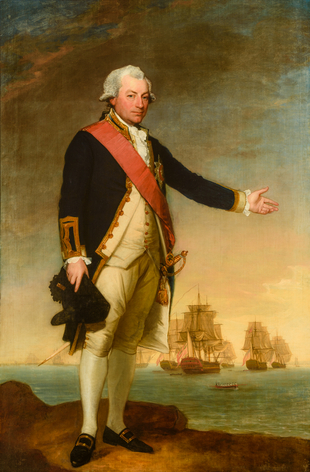
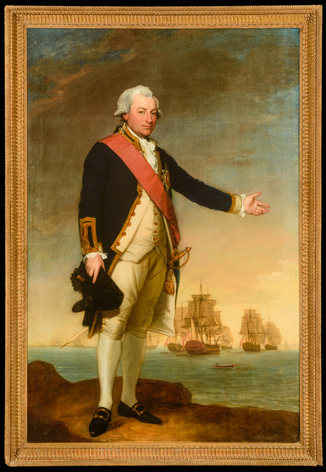
GILBERT STUART (American, 1755–1828)
Portrait of Captain Sir John Jervis, later First Earl of St. Vincent, about 1783–87
Oil on canvas, 88 3/16 x 55 1/2 in.
RECORDED: George Mason, The Life and Works of Gilbert Stuart (New York: C. Scribner’s Sons, 1879), p. 262 as “St. Vincent, Lord / Painted in England” // Mantle Fielding, “Paintings by Gilbert Stuart Not Mentioned in Mason’s ‘Life of Stuart,’” The Pennsylvania Magazine of History and Biography 38:3 (July 1914), pp. 325–26, no. 73 // Mantle Fielding, Gilbert Stuart’s Portraits of George Washington (Philadelphia: 1923), p. 31 // Lawrence Park, Gilbert Stuart: An Illustrated Descriptive List of His Works, vol. II (New York: W. E. Rudge, 1926), p. 888 no. 94 // Carrie Rebora Barratt and Ellen Miles, Gilbert Stuart, exhib. cat. [New York: The Metropolitan Museum of Art, 2004], pp. 28–29, 63 n. 1
EX COLL.: the artist; to Captain John Jervis, later 1st Earl of St. Vincent; to his sister, Mary Jervis Ricketts, likely by gift, by 1797; to her son, Edward Jervis Jervis, 2nd Viscount St. Vincent, until 1859; to his grandson, Carnegie Robert Jervis, 3rd Viscount St. Vincent, until 1879; to his son, John Edward Leveson Jervis, 4th Viscount St. Vincent, until 1885; to his brother, Carnegie Parker Jervis, 5th Viscount St. Vincent, until 1908; to his brother, Ronald Clarges Jervis, 6th Viscount St. Vincent, until 1940; to his son, Ronald George James Jervis, 7th Viscount St. Vincent, until 2006; to his son, Edward Robert James Jervis, 8th Viscount St. Vincent, until 2023; and by descent, until 2025
The genesis of Stuart’s portrait of John Jervis was first published by William Dunlap, who called Stuart “my old friend” and devoted over sixty pages in his History to “our greatest portrait painter.” Dunlap conveyed an anecdote he received from Stuart’s, friend and admirer, Charleston, South Carolina artist, Charles Fraser. Stuart told Fraser who told Dunlap that, “shortly after setting up his independent esel (sic)” in London, “‘Lord St. Vincent, the Duke of Northumberland and Colonel Barre, came unexpectedly one morning into my room, locked the door, and then explained the intention of their visit.’ They understood ... that I was under pecuniary embarrassments, and offered me assistance, which I declined. They then said they would sit for their portraits. Of course I was ready to serve them.’” (This quotation, widely reprinted in the Stuart literature is sometimes cited as originating in a letter from Stuart to Thomas Sully.) By the time that Stuart told the story, John Jervis had gone from Captain to Admiral and been awarded the title Earl of St. Vincent. The three men who visited Stuart’s studio that day in 1785 went on to play an important role in the success of Stuart’s career in London, commissioning multiple portraits from him. In 1785, Stuart painted Colonel Isaac Barré (1726–1802) (Brooklyn Museum, New York). Barré, who coined the phrase “Sons of Liberty” in a Parliamentary speech defending disgruntled American colonists, served as Paymaster of the Navy in 1782 and Paymaster General of the Forces in 1783. The Brooklyn portrait was originally owned by his friend, John Jervis. Two others are at the National Portrait Gallery, London, and at the Yale Center for British Art, New Haven, Connecticut. Hugh Percy, the Duke of Northumberland (1742–1817), became a major patron. Stuart moved into Northumberland’s estate, Syon House, where he painted Hugh Percy (High Museum, Atlanta), and The Children of the Duke of the Second Duke of Northumberland (collection of The Duke of Northumberland), as well as a full length portrait of Percy whose location remains unknown. Sometime between 1785 and 1787, when Stuart left London for Dublin, he painted the third member of the trio, Captain Sir John Jervis. During a lull in naval operations, Jervis, already a Commodore and soon to be an Admiral, entered Parliament and married Martha Parker, a cousin whose father was a member of the Royal Privy Council. Stuart painted at least two portraits of Jervis. One is an apparently unfinished portrait in the collection of the National Maritime Museum, Greenwich England, and the present work—the “not currently known” original—which has remained out of sight since it was painted with multiple generations of the Jervis family.
